
The global COVID-19 pandemic has brought behavioral changes in different areas of our lives, such as learning. The schools closed, the parents and those responsible for the children and adolescents find themselves with triple work between their usual jobs, taking care of the house and teachers of their children.
The negative impact that the coronavirus has is significant and immediate, one of the reasons being the existing digital divide and barriers to achieving inclusive access to the opportunities that digital infrastructure offers. The current situation sheds light on the importance of telecommunications development policies. Countries with more and better internet coverage have a better chance of converting their physical businesses to e-commerce and serving their regular customers or even attracting new customers.
In learning, it is possible to continue teaching and learning through e-learning, avoiding the loss of the school year or improving old skills, and discovering new capacities. Digital inclusion opens the door to training opportunities and quality information, fundamental elements for social and economic development. Investments in digital infrastructure can help narrow this gap and support the achievement of several sustainable development goals.
What is digital infrastructure?
According to the Royal Spanish Academy (RAE), infrastructure, in its traditional sense, is a set of elements or services needed for the creation and operation of any organization. The digital infrastructures are the elements and services necessary for the best connectivity of individuals through digital means such as telecommunications.
How does investment in telecommunications influence human capital in Latin America and the Caribbean?
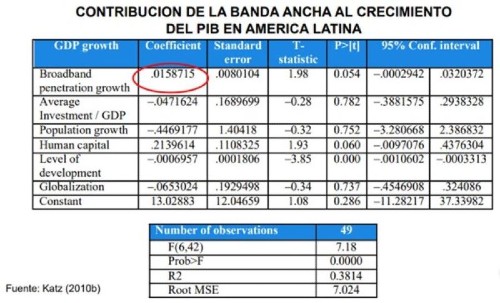
According to Dr. Raúl L. Katz in his work called “Broadband, digitization and development,” a 10% increase in broadband penetration in Latin America could contribute 0.16 points to GDP growth.
In the field of education, several empirical studies have already related human capital to the increase in a country’s GDP. As an example, we can cite Hanushek and Kimko (2000), who show that adding education to a basic specification that includes only initial income and the amount of education can explain an increase in GDP per capita among the 31 countries of their sample of 33% to 73%.

When we think of human capital related to education, we can think beyond formal education itself. The digital infrastructure is key to facilitating access to online education, be it formal school education or classes of specific skills such as massive and open online courses (MOOCs) or any other type of education and information. An excellent digital infrastructure facilitates and accelerates access to information and education.
The strengths of online education are:
- The flexibility of location eliminates physical isolation with the internet connection.
- Accessibility through the computer, tablet, or cell phone, reduces the physical space necessary to store different books and other teaching resources.
- Greater inclusion in education by facilitating the access of people with physical disabilities to education through technological resources, such as document readers.
- Update information immediately and inexpensively, thus avoiding the use of outdated materials.
- Options of long or short duration courses, by specific subjects (short duration), as well as graduations and master’s degrees (long term).
- Greater control of time spent studying, facilitating access to education for people who work.
- Savings in transportation and food.
- Opportunity to create a digital network of contacts, making it possible to locate work positions or people with the same interests to exchange data or joint jobs outside their cities.
But, if online education brings so many benefits, what are the challenges of connecting people from Latin America and the Caribbean with online education?
The study carried out by Antonio García Zaballos, Enrique Iglesias, Alejandro Adamowicz, in “The impact of digital infrastructure on the Sustainable Development Goals” quantifies the impact of digital infrastructure for each sustainable development goal (SDG) in 12 [1 ] countries of Latin America and the Caribbean (LAC). The theme of digital infrastructure in telecommunications and education fits into SDG 4: “Ensure inclusive, equitable and quality education and promote lifelong learning opportunities for all.”
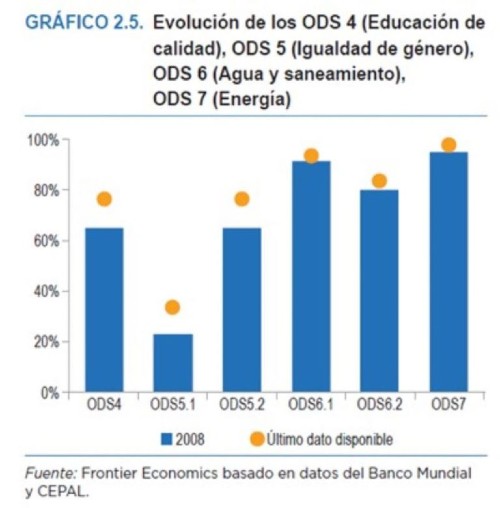
It has been noted that, in most countries, the estimated investment in telecommunications has increased between the years studied (2008-2017), specifically in Bolivia 240%, Argentina 127%, Costa Rica 120%, and Peru 104%. It is difficult to obtain exact conclusions and although we cannot establish a correlation between investment in the telecommunications sector and the evolution of the OCDS, the improvement in the same period is notable. For example, the quality education indicator measured as the net enrollment rate in secondary school grew from 65% to 77%.